

How To Draw Ripples In Cartoon Clothing
Drawing Dress Formulas
 We've learned formulas for every trunk part, however, people don't tend to walk around naked. We're usually wearing something. That something often wrinkle up and fold around united states of america as nosotros move.
In this lesson, we'll be dealing with how to handle drawing cartoon apparel. Specifically how to draw wrinkles and folds.
Here you volition find:
- Simple Drawing Folds
- The Four Most Common Cartoon Folds: Pipe Fold, Half Lock Fold, Spiral folds, Zig Zag Fold
- Fold Thickness and Fold Origin Points: Textile Types, Support Points and Pinch Points
- Using Fold to Describe Grade
- Costume and Clothes Ideas
- Applying The Folds to Cartoon Styles
In that location'southward a lot to this topic and I'yard not fifty-fifty telling y'all all of it. Just enough to get your cartoons to expect right. So let'southward get to it.
Elementary Cartoon Folds
The simples folds in cartoons can be washed with bumps in only the correct spots. Information technology's not too hard and early comic strip cartoons used them all the fourth dimension. If yous don't desire to become into annihilation complicated, this is the way to go:

All the same, when these types of simple folds are no longer enough and you want to have something that feels more natural, then information technology'due south time roll upwards your sleeves and become to know a scrap more about how folds work...
The Four Near Common Cartoon Folds
For the sake of this lesson, I decided to dribble the information into the folds most used in cartoons. These are not all the folds there are. There are a few other fold types I won't be covering here.
I'll explain the folds from what I retrieve, are the easiest folds to understand to the trickiest.
Pipe Fold
When fabric hangs off a back up point and simply gets pulled down by gravity, we go pipe folds. Pipe folds are cylindrically shaped folds, similar to a pipe.
From below, they ofttimes create multiple half pipes fastened together. They look similar this:

This is the easiest fold to wrap your head around. These fold are unremarkably seen in skirts, capes, and almost articles of vesture that loosely hangs off a person.
Spiral folds
Spiral folds are simple to understand equally well. In fact, the bumps used to create simple cartoon folds every bit explained above are more oftentimes than not, spiral folds.
Spiral folds are but pocket-sized cylinders that wrap around a body role like a spiral. They occur, mostly, when tight or class fitting textile bunches up.

They're ideal for defining the direction of the body function underneath the material.
Half Lock Fold
This is when things start getting a tad tricky. Half locks are folds that are created when two sections of the same piece of fabric interlock. In that location are two types. A unmarried half lock and a double half lock.
The single one-half occurs when ane part of the textile goes into another.
The double occurs when to parts of the cloth come up together and the cloth inverts and pushes out confronting itself:

This is extremely mutual. Information technology happens in pant legs and shirt sleeves someday they bend.
This ways this type of fold comes up a lot. And then larn to draw information technology. Information technology will immediately make your clothed cartoons wait more than natural.
Zig Zag Fold
I observe zig zag folds to the the trickiest of all the folds. They're sometimes made up of Pipe folds that are bunched up:

Lesser of pants legs and shirt sleeves are where you tend to encounter them.
Fold Thickness and Fold Origin Points
Now that you know some fold types to use, the catchy role is finding out how thick they should be and where all-time to put them. The answer comes when y'all think about gravity, material of the cloth and points of origin.
Cloth Types
Information technology'southward of import to know what material makes up the clothes.
Thinner fabric will have thinner folds and more of them.
Thicker cloth volition have bigger folds and less of them.

Merely you can still simplify the amount. Less is frequently more.
The origin of the fold is extremely of import. They tell you lot where the folds ought to be placed. Compression points and support points tell yous what you demand to know.
Support Points
Back up points or anchor points accept to do with gravity. Any loose textile is draped, supported or anchored up from somewhere. Once you lot pin bespeak those places you can then create the folds which are created from those points:

Pinch Points
Withal, people tend to move around. We curve and twist. This causes our wearing apparel to pinch upwardly in places. These pinch points crusade folds to happen, BUT they almost always indicate to a back up, or ballast bespeak:

Using Folds to Describe Form
Yeah, so far, that's a lot to go along track of. Well, there's one more very important thing that you demand to be aware of too when doing folds on clothes. They work all-time when the folds reinforce the form they are roofing or are draped over.
Remember how I talked about the arm and leg direction and keeping information technology consistent and clear? Role of the way you do it is with folds:
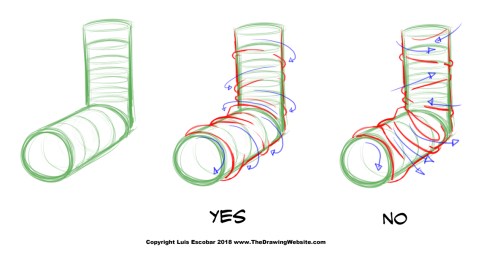
This is in spite of the fact that, in reality, folds sometimes go Confronting the management of the form beneath. This is where we take artistic license and h suit things and so that nosotros don't misfile anyone looking at our drawing.
Costume and Clothes Ideas
If yous're maxim to yourself, "okay, that's a lot but I think I understand, simply my trouble is, when I describe apparel on my characters, they await generic and often bromidic. How do I know what dress to requite my characters?"
It's unproblematic, wait around you. People are wearing clothes all around. Look online, search for the type of clothes you may want to accept your characters wear.
If information technology's historical, fantasy or science fiction, so you look online for reference for that as well. Annihilation fantastical or from a science fiction background should be some amalgam of contemporary and historical article of clothing anyway.
That way, it has an element of truth to it. That'due south what designer for moving-picture show and television set bear witness exercise.
Do some research. It'south that simple.
Applying The Folds to Cartoon Styles
When speaking of folds in cartoons, simplicity is the name of the game. The overarching theme in all these styles is how they simplify the folds.

Freddy Moore
Freddy Moore style, out of these three styles has the most balanced corporeality of simple folds. Not besides much then that information technology's representational just not so simple that the folds are still there.
This makes it so that balancing the amount of folds can be tricky but they also await just correct when you nail it:

Turnarounds


Bruce Timm
Bruce Timm Mode folds fluctuate a lot. Sometimes they're so minimal that they practically don't exist, while other times they can be quite elaborate. It actually depends on the type of drawing you're making and how simple you lot want to become with information technology.
In the examples below, I show you how folds can be fatigued in the mode in instance you really want to run across them:

The turnarounds beneath, basically have no folds at all. This is, mostly, the default folds of this manner...
Turnarounds


Takahiro Kimura Anime Way
Kimura way is past far the most elaborate. It actually tries as best every bit information technology can to exist representational when it comes to folds. Notwithstanding, there is some level of simplification to this style:

Turnarounds



Source: http://www.thedrawingwebsite.com/2018/05/09/cartoon-clothes-formulas/
Posted by: caponecestion.blogspot.com
0 Response to "How To Draw Ripples In Cartoon Clothing"
Post a Comment